

Behind better outbreak response: Malawi and the Central African Republic
Outbreak response depends on speed. But teams cannot move quickly if they cannot see what is happening, decide what matters, follow up, and remove the bottlenecks that slow implementation. That execution challenge sat at the centre of Amp Health’s support to the Strengthening Outbreak Notification and Response programme, known as SONAR.
SONAR is a Global Fund initiative implemented by the Task Force for Global Health. For nine months, Amp Health supported two SONAR partnerships: with CAR’s Directorate for Surveillance and Public Health Emergencies and with the Public Health Institute of Malawi, with a clear focus on programme execution. In both countries, teams were working hard, but plans were not consistently being delivered.
In CAR, overall budget absorption was around 30%, with some programme components at just 6%. In Malawi, misalignment between the Global Fund Principal Recipient Unit and the Public Health Institute reinforced siloed work and slowed progress. Across both settings, the symptoms were familiar: unclear roles, fragmented reporting, slow procurement, low visibility of progress, and a reactive working culture.
Amp Health’s support focused on building a simple but disciplined execution system: plan, track, decide, unblock. Embedded Management Partners worked with the teams to introduce regular review meetings and masterclasses, clarify priorities and responsibilities, and use dashboards, weekly trackers, activity summaries, and standardised meeting minutes to manage work more effectively. The aim was straightforward: to help teams see where work was stuck and move it forward.
After nearly a year of embedded support, the results are starting to show.
Malawi: proactive planning and AI-enabled support
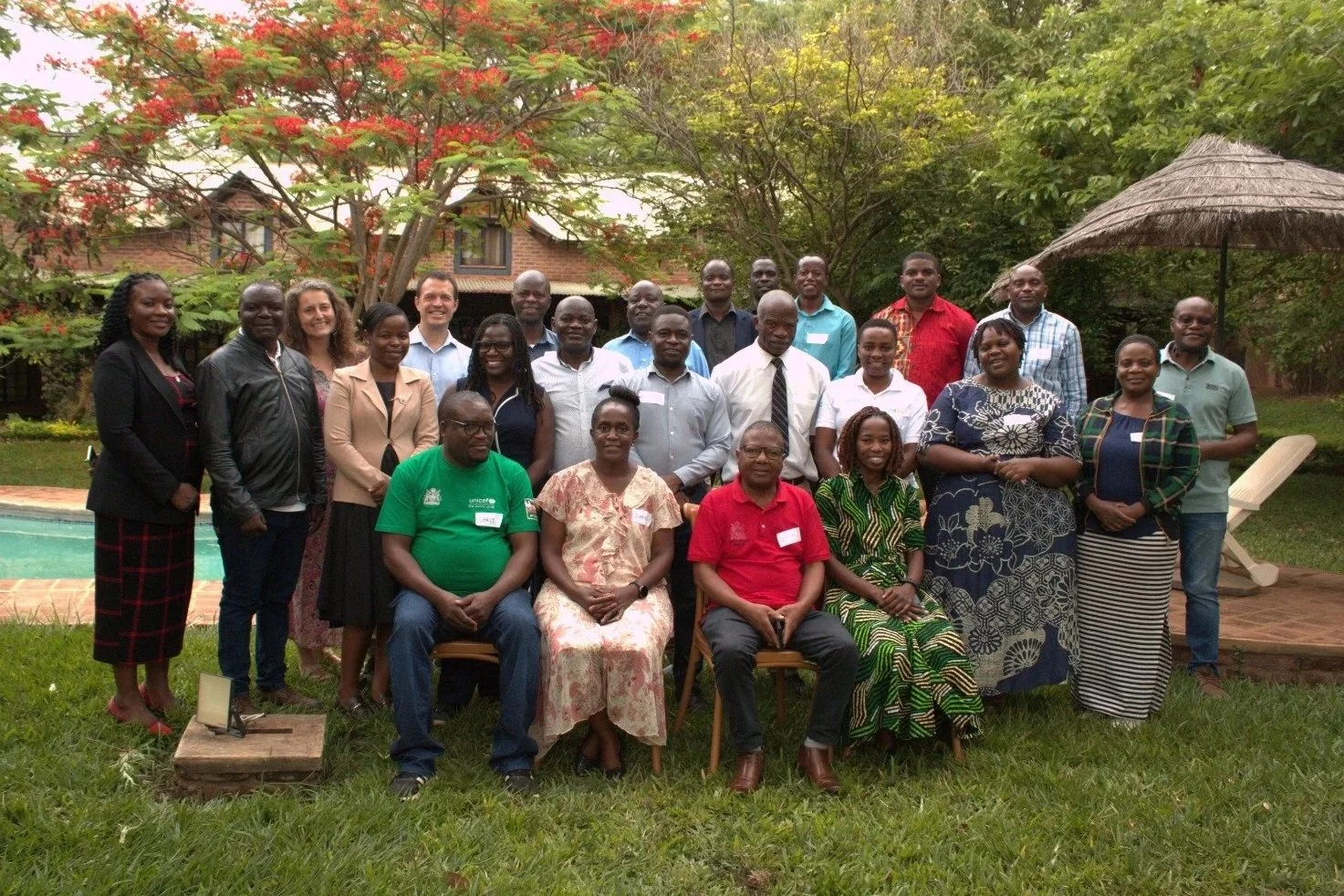
Amp Health’s Management Partner, Andeh Hyeroba, worked closely with the national disease surveillance team to strengthen planning, coordination, and innovation uptake. Drawing on his experience supporting a previous Amp Health partnership in Guyana, Andeh guided the team through their pilot of an AI chatbot that provides real-time information on Mpox and cholera. The tool is designed to support faster access to accurate information, helping frontline workers and decision-makers respond more effectively during outbreaks.
Alongside this innovation, the team developed a six-month work plan that integrates Event-Based Surveillance (EBS) across animal, environmental, and human health systems within Malawi’s national One Health Surveillance Platform. This represents an important step towards breaking down long-standing siloes and strengthening cross-sector collaboration.
Capacity strengthening has also been a major focus. To date, more than 14,000 health workers have been trained in EBS across 13 districts, exceeding the original target by 11 districts. This expanded reach is helping to ensure that potential outbreak signals are identified earlier and escalated more consistently from community to national level.
Central African Republic: accelerating delivery and improving budget absorption
In CAR, the work took an equally pragmatic form. Amp Health supported weekly epidemic data meetings, planning and stakeholder-mapping tools, and a dual meeting structure that separated internal operations from wider multisectoral data sharing and action. That gave the surveillance programme a better way to manage two different demands at once: disciplined internal follow-through and broader coordination across the health system. Reporting improved. Friction with partners decreased. Regular updates became timely enough to reach the Minister of Health.
Priorities were reset. Owners were assigned to critical activities. Weekly reviews became routine. Cross-unit follow-up became more consistent. Weekly reports made 85% to 90% of activities visible in real time, while more than 95% of planned action items were on track to be achieved before the end of the grant.
Stronger execution also helped the programme team in CAR move more effectively on frontline work. Across eight districts, 3,058 community health workers received EBS training, while 75 were trained on the One Health application to strengthen integrated frontline reporting. This has strengthened CAR’s ability to detect outbreaks closer to where they began. These were programme-team achievements, not Amp Health outputs. They matter because they show what better coordination, clearer follow-through, and stronger management practices helped make possible.
Another key breakthrough in CAR has been the introduction of accelerated action planning. Previously, the team struggled with low budget absorption, which delayed implementation and limited the impact of planned activities. With focused support on prioritisation, planning, and execution, 80% of planned activities are now on track. This improvement is enabling the team to make better use of available resources and deliver against their objectives more consistently.
Building resilient surveillance systems for the future
Across both countries, this partnership demonstrated that effective disease surveillance is not only about tools and training, but about how teams work together. As global health threats continue to evolve, strong, well-coordinated disease surveillance systems are essential to protecting public health. By strengthening leadership, programme management, and cross-sector coordination, the DSDs in Malawi and CAR are better positioned to detect outbreaks early and respond with precision.
The lessons learned through this partnership extend beyond CAR and Malawi. Outbreaks do not wait for systems to be ready. The countries that respond most effectively are those that have already invested in the capabilities needed to act quickly when threats emerge.